Monday, February 18, 2013

12 Books I Read in 2012 (by Stephen Simpson)


A few years ago, I started keeping a list (via spreadsheet) of all the books that I finish.  I have found it tremendously useful in helping me remember what I have read.  Here is a quick look at what I read in 2012.

  • The Myth of the Garage - read this book for free on my kindle; I think I know why it was free; 
  • Going Public - Your Child Can Thrive in Public School - an excellent book; probably the best book I read in 2012.  Read a blog post I wrote about this book.
  • The Rockefellers - This book I borrowed from Pastor Osborne's office.  It is a long book.  But, I enjoyed learning about this family and the vast amounts of wealth that they had to deal with. 
  • License to Pawn - If you like the show Pawn Stars, you will like this book.  It is the story of Rick Harrison, the main character of the show.  He has not lived the cleanest life, so it is not the cleanest book.  But, I found it very interesting. 
  • The Hunger Games Trilogy - Brace yourself...I did not enjoy these books.  I read them all and just failed to connect with the story.  To me, it was all pretty dumb.  But, that's just my opinion.
  • Seal Team Six - Memoirs of an Elite Navy Seal Sniper - The author, a retired member of Seal Team 6, writes about his experiences.  I found this book fascinating.
  • The Hands-On Dad - heard this author speak at the FPEA Homeschool Convention and borrowed his book from the library.  Short book, but really good for Dads of homeschoolers.
  • Liar's Poker - another book I read for free on my kindle; another waste of time
  • Ivanhoe - classic book; Robin Hood, Richard the Lionheart, a timeless tale; what more could you ask for?  I literally could not put this book down.  
  • Tempted and Tried - I loved the first book by this author (Adopted for Life).  I struggled to connect with this one.  It dealt with the temptations of Jesus.  I think it is an excellent book, my brain just had a difficult time working through it.

As I look back on what I read in 2012, frankly I am somewhat disappointed.  I did not enjoy nor benefit from much of what I read.  The highlights were Going Public, The Rockefellers, and Ivanhoe.  They stood out far above the rest.  Others like License to Pawn and Seal Team Six were 'just for fun' and I enjoyed them.  The rest of these books were notable in that they were dreadfully forgettable.  

I am resolved to make better choices in what I read in 2013.  With all of the books that are available to read, there is no excuse for reading a dud!

Now it's your turn.  Leave a comment below.  Did you read any of these books?  What did you think about them?  What books did you read in 2012?  

Related Posts:

Friday, December 21, 2012

Birds of the Bible - At the Manger

(originally posted on December 24, 2009)

Eurasian Collared Dove (Streptopelia decaocto) by Reinier
And it came to pass in those days that a decree went out from Caesar Augustus that all the world should be registered. This census first took place while Quirinius was governing Syria. So all went to be registered, everyone to his own city. Joseph also went up from Galilee, out of the city of Nazareth, into Judea, to the city of David, which is called Bethlehem, because he was of the house and lineage of David, to be registered with Mary, his betrothed wife, who was with child. So it was, that while they were there, the days were completed for her to be delivered. And she brought forth her firstborn Son, and wrapped Him in swaddling cloths, and laid Him in a manger, because there was no room for them in the inn. (Luke 2:1-7 NKJV)
Most Christians know the passage in Luke 2 about the birth of our Savior, the Lord Jesus Christ. Many others have heard that passage read each Christmas. The birth of Jesus, who was born to die. "Although our first picture of Jesus is as a baby in a manger, it must not be our last. The Christ child in the manger is the subject of a beautiful Christmas scene, but we must not leave him there. This tiny, helpless baby lived an amazing life, died for us, ascended to heaven, and will return to earth as King of kings. Christ will rule the world and judge all people according to their decisions about him. Do you still picture Jesus as a baby in a manger—or is he your Lord? Make sure you don't underestimate Jesus. Let him grow up in your life." (Life Application Study Bible)

Joseph and Mary were not so poor that they could not afford a room at the end, but "there was no room for them in the inn." Because of the registrations going on, each had to show up in their own city. According to the Jewish mode of registration the people would be enrolled by tribe, families or clans, and households. "But David occasionally went and returned from Saul to feed his father's sheep at Bethlehem." (1 Samuel 17:15 NKJV).

Micah prophesied in Micah 5:2:
But thou, Bethlehem Ephratah, though thou be little among the thousands of Judah, yet out of thee shall he come forth unto me that is to be ruler in Israel; whose goings forth have been from of old, from everlasting.
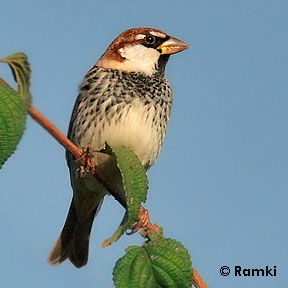
Spanish Sparrow (Passer hispaniolensis) by Nikhil Devasar"This mention of the manger is the basis for the traditional belief that Jesus was born in a stable. Stables were often caves with feeding troughs (mangers) carved into the rock walls. Despite popular Christmas card pictures, the surroundings were dark and dirty. This was not the atmosphere the Jews expected as the birthplace of the Messiah-King. They thought their promised Messiah would be born in royal surroundings. We should not limit God by our expectations. He is at work wherever he is needed in our sin-darkened and dirty world." (Life Application Study Bible)

All of the above was to set the location for the manger and why in my imagination, I believe birds would have been around the manger. There are no verses in the Bible to show there were birds there, nor are there any to show that lambs, cows, or horse were there either, as depicted in our Christmas scenes. So, here is what birds I think may have been there at Jesus' birth.

Doves - "You who dwell in Moab, Leave the cities and dwell in the rock, And be like the dove which makes her nest In the sides of the cave's mouth." (Jeremiah 48:28 NKJV)

Turtledoves - The flowers appear on the earth; The time of singing has come, And the voice of the turtledove Is heard in our land." (Song of Solomon 2:12 NKJV)

Chickens and Roosters by MajiSparrows and Swallows- "How lovely is Your tabernacle, O LORD of hosts! My soul longs, yes, even faints For the courts of the LORD; My heart and my flesh cry out for the living God. Even the sparrow has found a home, And the swallow a nest for herself, Where she may lay her young— Even Your altars, O LORD of hosts, My King and my God." (Psalms 84:1-3 NKJV) If they wanted to be at the altars or house of God, then surely, they wanted to be near their Creator.

Chickens and Roosters - "O Jerusalem, Jerusalem, the one who kills the prophets and stones those who are sent to her! How often I wanted to gather your children together, as a hen gathers her chicks under her wings, but you were not willing! (Matthew 23:37 NKJV) and Jesus said to him, "Assuredly, I say to you that this night, before the rooster crows, you will deny Me three times." (Matthew 26:34 NKJV) Cave or Stable, there had to be Chickens, Hens, and Roosters.

Ravens - Who provides food for the raven, When its young ones cry to God, And wander about for lack of food? (Job 38:41 NKJV) They wanted to be near the One who has been feeding them.
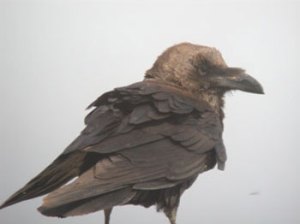
Brown-necked Raven of IsraelI would think, in my "sanctified imagination," that since the Lord created everything, birds included, that they might have been eager to see their Creator. Many humans failed to recognize Him while He was on earth, but I think the critters knew who He was. For example, the un-ridden donkey the Lord rode on. There is no report of it trying to buck or misbehave. It knew!

There are more kinds of birds that might have been there, but I will leave those to your imagination. Have a Merry Christmas as you consider the true meaning of the Lord's birth.


Produced by Sean Fielder and Pastor Jerry Smith
Photos-Eurasian Collared Dove (Streptopelia decaocto) by Reinier, Red Turtle Dove by Nikhil, Spanish Sparrow (Passer hispaniolensis) by Nikhil Devasar, Chickens and Roosters by Maji, Brown-necked Raven, Israel

Wednesday, December 19, 2012

The Cup of Christmas (by Matthew DelValle)

(originally published December 22, 2010)
39 And he came out and went, as was his custom, to the Mount of Olives, and the disciples followed him. 40 And when he came to the place, he said to them, “Pray that you may not enter into temptation.” 41 And he withdrew from them about a stone’s throw, and knelt down and prayed, 42 saying, “Father, if you are willing, remove this cup from me. Nevertheless, not my will, but yours, be done.” 43 And there appeared to him an angel from heaven, strengthening him. 44 And being in an agony he prayed more earnestly; and his sweat became like great drops of blood falling down to the ground. 45 And when he rose from prayer, he came to the disciples and found them sleeping for sorrow, 46 and he said to them, “Why are you sleeping? Rise and pray that you may not enter into temptation.”  (Luke 22:39-46)

During the Christmas season we are reminded of the truth of the Incarnation. The Incarnation is that God the Son—Jesus Christ—took on human flesh. He became one of us. He was born of a woman (Gal. 4:4). He lived under the authority and instruction of His parents (Luke 2:41-52). He had brothers and sisters (Luke 8:19-21). He ate when He was hungry (Luke 7:36). He drank when He was thirsty (John 4:7). He slept when He was tired (Luke 8:23). He cried when He was sad (John 11:35). He was like us in every respect (Heb. 2:17), yet without sin (Heb. 4:15). Christmas reminds us of all these truths.

In this passage from Luke 22 we catch another glimpse at the humanity of Jesus: He sweated. We have all sweated before. But have you sweat so hard drops of blood fell from your face? There is a condition known as hematidrosis where extreme anguish or physical strain causes the blood vessels to burst, mixing blood with sweat. Jesus was undergoing such anguish. Matthew’s account records Jesus saying, “My soul is very  sorrowful, even to death” (Matt. 26:38). Jesus was experiencing the most extreme level of anguish. Why? It was because of His Father’s cup that He knew He must drink (John 18:11).

The Cup
I want to camp out on this “cup” for a moment. In the Old Testament the cup was a metaphor for God’s wrathful judgment upon sin. In Psalm 75:8 Asaph wrote, “For in the hand of the LORD there is a cup with foaming wine, well mixed, and he pours out from it, and all the wicked of the earth shall drain it down to the dregs.” The prophet Isaiah echoes this language, “Wake yourself, wake yourself, stand up, O Jerusalem, you who have drunk from the hand of the LORD the cup of his wrath, who have drunk to the dregs the bowl, the
cup of staggering” (Isa. 51:17). In both of these Old Testament passages it is the wicked who are to drink the cup of God’s wrath. They are the ones who deserve judgment, and therefore they are the ones who drain the cup down to the dregs.

Yet here in Luke’s Gospel we read something startling: Jesus is asking the Father if He is willing to remove a cup from Him. God the Father had prepared a cup of wrath for God the Son to drink to the full. It was as if God the Father was saying, “In the hand of the LORD there is a cup with foaming wine, well mixed, and I pour out from it, and my only begotten Son shall drain it down to the dregs.”

Jesus knew He was to drink the cup of His Father’s wrath. He knew what awaited Him at His crucifixion. It wasn’t death at the hands of lawless men that put Jesus into agony. It wasn’t even the horrific death of crucifixion. Jesus had taught His disciples, “I tell you, my friends, do not fear those who kill the body, and after that have nothing more that they can do. But I will warn you whom to fear: fear him who, after he has killed, has authority to cast into hell” (Luke 12:4-5). No, what Jesus agonized over in the garden of Gethsemane was not murder by sinful men. What Jesus agonized over was drinking His own Father’s cup. That’s why He ended His prayer by saying, “Nevertheless, not my will, but yours, be done” (Luke 22:42). “It was the will of the LORD to crush him” (Isa. 53:10).

When Jesus cried out from the cross, “My God, my God, why have you forsaken me?”, that wasn’t hyperbole (Matt. 27:46). Jesus wasn’t just saying how He felt. He didn’t merely feel forsaken. He was forsaken. He was bearing the full weight of the wrath of God against all law-breaking, glory-trading, God-dishonoring sin upon Himself. Every bitter thought, every evil deed—all the sins of everyone who would believe in Him Jesus took upon Himself. If ever there was a person truly forsaken—in the deepest sense of the word—it was Jesus. He drank the cup down to the dregs.

Christ Our Curse
Galatians 3:13 says, “Christ redeemed us from the curse of the law by becoming a curse for us—for it is written, ‘Cursed is everyone who hangs on a tree.’” The reason Jesus was forsaken by His Father is because He was cursed by His Father. That is literally what happened at Golgotha. The Father couldn’t even bear to look at His Son, who had become a mass of sin. The very sight of it disgusted Him because all He saw was filth. That is what is meant when we read, “He became sin who knew no sin” (2 Cor. 5:21). Christ became sin.

Think about this: The eternity of punishment that the wicked will experience will not compare to the wrath that was inflicted upon our Lord. It will not be equal. They will only experience the due punishment for one person’s sins—their own. No more, no less. Christ took the punishment of wrath not for one person but for billions of people. That is punishment upon punishment, wrath upon wrath, multiplied billions of times over. And what normally takes an eternity to unleash was concentrated into the most intense three hours that can be conceived. 6-week summer classes are harder than 16-week semester classes; try cramming an eternity of punishment into 3 hours. The cross was a crash course in experiencing the holy wrath of Almighty God.

I think that’s why Jesus prayed so hard His sweat became blood. It was His last opportunity to commune with His Father before He would be totally and utterly forsaken. In a matter of hours, the Father would turn His back on His Son. He would not listen to Him. He would curse Him. That’s why Luke records in verse 44 that Jesus was in agony. What could be more agonizing? He was about to experience the wrath of His Father.

Saved From God’s Wrath
So what are you saved from? If someone asks you, “Are you saved?” what do they mean? Saved from what? Friends, if we have repented of our sins and believed in our hearts that Jesus Christ is Lord, we have been saved from God Himself. We aren’t saved from hell. Hell wasn’t mad at us. We’re saved from God, and His righteous wrath against our rebellious, cosmic treason. In my place—in my place!—condemned He stood.

I love these words from John Stott about Christ’s death on the cross: “[The cross] is an appeasement of the wrath of God by the love of God through the gift of God. The initiative is not taken by us, nor even by Christ, but by God himself in sheer unmerited love. His wrath is averted not by any external gift, but by his own self-giving to die the death of sinners. This is the means he has himself contrived by which to turn his own wrath away.” To which I say, “Hallelujah!”

We are saved from God, by God, for God. Now God is no longer angry with us but only and forevermore our merciful Father. That, my friends, is amazing grace. Thank you, Jesus, for drinking the cup for me.

Man of Sorrows! what a name
For the Son of God, who came
Ruined sinners to reclaim.
Hallelujah! What a Savior!

Bearing shame and scoffing rude,
In my place condemned He stood;
Sealed my pardon with His blood.
Hallelujah! What a Savior!

Guilty, vile, and helpless we;
Spotless Lamb of God was He;
“Full atonement!” can it be?
Hallelujah! What a Savior!

Lifted up was He to die;
“It is finished!” was His cry;
Now in Heav’n exalted high.
Hallelujah! What a Savior!

When He comes, our glorious King,
All His ransomed home to bring,
Then anew His song we’ll sing:
Hallelujah! What a Savior!


Other posts by Matthew DelValle:

Friday, December 14, 2012

God's Perfect Timing (by Lou Gentry)

(originally posted on December 17, 2010)


In a recent sermon, Pastor Osborne alluded to God's perfect timing of Jesus' birth. As one example of this perfect timing, consider the fact that when Jesus was born one language was used for communication throughout the civilized world. This phenomenon was a result of the conquests of Alexander the Great, who conquered the world linguistically as well as physically. The world was unified by the koine Greek language, and the apostles wrote the New Testament and preached the gospel in this language.

Other examples of God's perfect timing of the birth of Jesus include the fact that the entire world had come under the one government of Rome--a single citizenship for all. The Romans had also constructed roads throughout their vast empire and protected them from vandals and thieves. This enabled commerce and travel to flourish. These three factors allowed Paul and the early Christians to travel the length and breadth of the empire in relative safety to share the gospel from Palestine to Spain.

So with a unifying language, a single citizenship, and roads connecting every part of the empire, the physical world was prepared for the coming of Jesus. These factors also allowed Caesar Augustus to order a census of the entire Roman world, thereby bringing Mary and Joseph to Bethlehem where, as prophesied, the virgin would give birth to the Messiah in the city of David.

There are many of us today who are waiting for God to work in our life; and, as we wait, we should remember God's perfect timing in the sending of His Son. Let us pause during this Christmas season and thank our Heavenly Father for His wisdom and His ability to perfectly order the events of our lives, including the most important event--Christ's coming.

Other Articles by Lou Gentry:

    Monday, December 10, 2012

    Sermon Archives: The Rage of the Maniacal Mad Monarch

    (originally posted on December 13, 2010)


    Some of you may remember a series of Christmas messages that Pastor Osborne preached in 2006 entitled "The Voices of Christmas."  Each message centered around one of the characters in the Christmas story and featured a monologue from that character.  One of the messages was entitled "The Rage of the Maniacal Mad Monarch" and featured David Tucker as King Herod.  Listen to it on our website.


    Related Posts:

    Wednesday, November 21, 2012

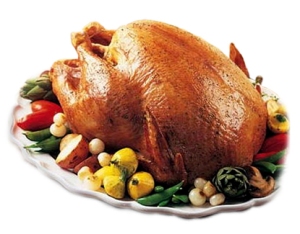
    Thanksgiving Turkey (by Lee Dusing)


    Tomorrow, many of us here in the United States will be eating turkey on Thanksgiving Day. Luckily, many turkeys will survive our holiday and continue to roam around. Here locally in Polk County, Florida, I see a "rafter" of turkeys (name for a group of turkeys - incorrectly called a "gobble" or "flock") from time to time. Near Bartow I have seen them many times in rafters up to 11 turkeys. Near Circle B Bar Reserve, I have seen other groups up to 8 turkeys.
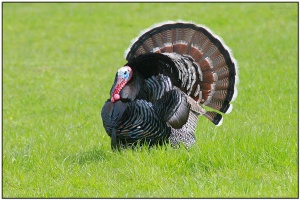
    Wild Turkey (Meleagris gallopavo) by Daves BirdingPixThe domestic turkey is a descendant of the Wild Turkey and features prominently in the menu of the Canadian and U.S. holidays of Thanksgiving and that of Christmas in many countries.

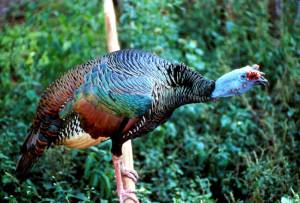
    The Turkey is in the Galliformes Order and in the Phasianidae (Pheasants, Fowl & Allies) Family. There are two turkeys - Wild Turkey - Meleagris gallopavo and the Ocellated Turkey - Meleagris ocellata. The Wild is native to North American forrests and the Ocellated is native to the Yucatan Peninsula forrests. They are relatives of the Grouse family. Both Turkeys have a "distinctive fleshy wattle that hangs from the underside of the beak and a fleshy protuberance (flap of skin) that hangs from the top of its beak called a snood." Turkeys are the heaviest member of the Galliformes order. The females are smaller and duller than the males. The male weighs from 11-24 lbs (5-11 kg) [record=38lbs] and measures 39-49 in (100-125 cm). They also have from 20,000-30,000 feathers.
     Ocellated Turkey (Meleagris ocellata) ©USFWS
    Congressional Proclamations from CreationWiki.
    "The United States Congress set December 18, 1777, as a day of thanksgiving on which the American people "may express the grateful feelings of their hearts and consecrate themselves to the service of their divine benefactor" and on which they might "join the penitent confession of their manifold sins . . . that it may please God, through the merits of Jesus Christ, mercifully to forgive and blot them out of remembrance." Congress also recommends that Americans petition God "to prosper the means of religion for the promotion and enlargement of that kingdom which consisteth in righteousness, peace and joy in the Holy Ghost.'"[1]
    Congress set November 28, 1782, as a day of thanksgiving on which Americans were "to testify their gratitude to God for his goodness, by a cheerful obedience to his laws, and by promoting, each in his station, and by his influence, the practice of true and undefiled religion, which is the great foundation of public prosperity and national happiness."
    Giving thanks always for all things unto God and the Father in the name of our Lord Jesus Christ; (Ephesians 5:20 KJV)
    See:
    WhatBird's Wild Turkey
    Wikipedia's Wild Turkey and Ocellated Turkey
    Video of an Ocellated Turkey and a Wild Turkey displaying on Internet Bird Collection

    (originally posted on November 25, 2009)

    Monday, November 19, 2012

    Abraham Lincoln, His God, and Thanksgiving (by Peter Brock)


    Please take a moment to read the introduction to Abraham Lincoln's Thanksgiving proclamation and then spend a few moments reading his words declaring Thanksgiving a national holiday.His recognition of the providential hand of Almighty God in his personal life and the life of the nation should humble us all.

    In early July of 1863, there were some 50,000 American casualties at the Battle of Gettysburg, and President Lincoln traveled to the field of battle some four months afterward to deliver the "Gettysburg Address." Deeply moved by the sacrifice of these soldiers, Lincoln first committed his life to Christ while walking among the graves there. He later explained: "When I left Springfield [to become President] I asked the people to pray for me. I was not a Christian when I buried my son, the severest trial of my life, I was not a Christian. But when I went to Gettysburg and saw the graves of thousands of our soldiers, I then and there consecrated myself to Christ."

    During this time of internal strife in the United States, and at this turning point in his own spiritual life, President Lincoln issued the following proclamation.


    PROCLAMATION OF THANKSGIVING BY THE PRESIDENT OF THE UNITED STATES OF AMERICA

    The year that is drawing toward its close has been filled with the blessings of fruitful years and healthful skies. To these bounties, which are so constantly enjoyed that we are prone to forget the Source from which they come, others have been added which are of so extraordinary a nature that they can not fail to penetrate and soften even the heart which is habitually insensible to the ever-watchful providence.... 
    In the midst of a civil war of unequaled magnitude and severity, which has sometimes seemed to foreign states to invite and to provoke their aggression, peace has been preserved with all nations, order has been maintained, the laws have been respected and obeyed, and harmony has prevailed everywhere, except in the theater of military conflict, while that theater has been greatly contracted by the advancing armies and navies of the Union. 
    Needful diversions of wealth and of strength from the fields of peaceful industry to the national defense have not arrested the plow, the shuttle, or the ship; the ax has enlarged the borders of our settlements, and the mines, as well of iron and coal as of the precious metals, have yielded even more abundantly than theretofore. 
    Population has steadily increased notwithstanding the waste that has been made in the camp, the siege, and the battlefield, and the country, rejoicing in the consciousness of augmented strength and vigor, is permitted to expect continuance of years with large increase of freedom. 
    No human counsel hath devised nor hath any mortal hand worked out these great things. They are the gracious gifts of the Most High God, who while dealing with us in anger for our sins, hath nevertheless remembered mercy. It has seemed to me fit and proper that they should be solemnly, reverently, and gratefully acknowledged, as with one heart and one voice, by the whole American people. I do therefore invite my fellow-citizens in every part of the United States, and also those who are at sea and those who are sojourning in foreign lands, to set apart and observe the last Thursday of November next as a day of thanksgiving and praise to our beneficent Father who dwelleth in the heavens. And I recommend to them that while offering up the ascriptions justly due to Him for such singular deliverances and blessings they do also, with humble penitence for our national perverseness and disobedience, commend to His tender care all those who have become widows, orphans, mourners, or sufferers in the lamentable civil strife in which we are unavoidably engaged, and fervently implore the interposition of the Almighty Hand to heal the wounds of the nation and to restore it, as soon as may be consistent with the Divine purposes, to the full enjoyment of peace, harmony, tranquility, and union. 
    In testimony whereof I have hereunto set my hand and caused the seal of the United States to be affixed.

    Abraham Lincoln (October 3, 1863, passed by an Act of Congress.)

    (Originally Posted November 21, 2007)

    Friday, November 16, 2012

    Thankful for the Freedom to Worship God (by Lou Gentry)

    (originally posted November, 24, 2010)

    The First Thanksgiving, painting by Jean Louis Gerome Ferris
    In this season of Thanksgiving, I was led to read once again the words of the official Thanksgiving  Proclamation issued by Governor William Bradford on November 29, 1623. Bradford was the leader of the Pilgrims and was elected as Governor of the Plymouth Colony in 1621, and reelected every year until his death in 1657, except for five years in which he declined. Here is his proclamation issued three years after the Pilgrims' arrival and two years after the first Thanksgiving:

    "To all ye Pilgrims:
    In as much as the great Father has given us this year an abundant harvest of Indian corn, wheat, peas, beans, squashes, and garden vegetable, and has made the forests to abound with game and the sea with fish and  clams, and inasmuch as he has protected us from the ravages of the savages, has spared us from pestilence  and disease, has granted us freedom to worship God according to the dictates of our own conscience; now I, your magistrate, do proclaim that all ye Pilgrims, with your wives and ye little ones, do gather at ye meeting  house, on ye hill, between the hours of 9 and 12 in the day time, on Thursday, November ye 29th, of the year of our Lord one thousand six hundred and twenty-three, and the third year since ye Pilgrims landed on ye  Pilgrim Rock, there to listen to ye pastor and render thanksgiving to ye Almighty God for all His blessings. 
    William Bradford, Ye Governor of Ye Colony."
    [William J. Federer, America's God and Country: Encyclopedia Of Quotations (Coppell, Texas: FAME Publishing, Inc., 1994), p. 66]

    As I consider all that I have to be thankful for during this season of the year, I am led to include the courage of the Pilgrims and their desire for "freedom to worship God." It would benefit all of us, I believe, to contemplate whether we would have anything to celebrate during this season had it not been for their courage and belief in God.

    Tuesday, November 13, 2012

    A Tale of Two Piano Teachers (by Stephen Simpson)


    Over 23 years ago, I took my first piano lesson.  I was 8 years old.  It is hard to believe that I have been playing the piano for 23 years.  Over my musical 'career,' I have studied piano with at least 5 different piano teachers.  Most of them taught me for only a year or two.  I benefited from every one of them.  However, two of them stand out above all the rest.  One taught me to love the piano.  The other taught me to excel at piano.

    A Love for the Piano
    In 1990, I began 3rd grade at Lakeland Christian School (LCS).  There were many things about 3rd grade that I did not like.  However, during my 3rd grade school year, I began taking piano lessons from Audrey Parrish at LCS.  My memories of her are similar to a child's memories of a loving grandparent.  She was kind and patient.  She taught me to love the piano.  Mrs. Parrish carefully took me through each of the piano method books.  I never remember her losing her temper or being frustrated.  For 6 years she invested in my life.  I can still remember a day during the summer between 8th & 9th grade.  A letter came to my house informing us that Mrs. Parrish was retiring from teaching piano at LCS.  I remember crying.  Imagine an 8th grade boy crying at the loss of his piano teacher.  This should communicate volumes to you about Audrey Parrish. 

    Recently, I learned that Mrs. Parrish had passed away.  I will never forget the investment that she made in my life.  She taught me to love the piano.

    Excellence at the Piano
    In the fall of 1999, I entered Bob Jones University as a freshman Music Education major.  As I arrived on campus, I did not personally know anyone in the music department.  As a piano principal, I was required to audition.  In God's providence, I was assigned to the piano studio of Dr. Susan Kindall.  Looking back, this decision was the pivotal point of my four years in college.

    Having already developed a deep love for the piano, Dr. Kindall taught me to excel at the piano.  I developed a strong technique at the piano that has helped me tremendously as I accompany and teach.  She pushed me to set high expectations and to not settle for 'good enough.'  Even though I was a Music Education major, she taught me as if I were a Piano Performance major.  At my juries, I was often commended by other teachers for exceeding the requirements of a Music Education major.  For Dr Kindall, it was never about meeting the minimum requirements.  It was about maximizing my potential for the glory of God.

    Watching Dr. Kindall, I learned how to be a strong Christian while interacting with a lost world.  Dr. Kindall would frequently bring guest artists to the campus who were not Christian.  Her testimony to them was above reproach.  

    I will never forget Mrs. Parrish or Dr. Kindall.  All of the students who I teach feel the effects of these two teachers.  Each day, as I teach, I am working to inspire my students to love the piano while at the same time pushing them towards excellence.

    May God grant us many more teachers like Audrey Parrish and Susan Kindall.

     
    Related Posts:


    This Post Sponsored by:

    Tuesday, October 23, 2012

    Can We Trust the Bible: History of Progress Toward Canonization for the OT


    History of Progress Toward Canonization for the OT

    At the time of Christ, the OT canon included the 39 OT books which are found in today’s English Bible. This is confirmed in the writings of the great Jewish historian Josephus (A.D. 37-95). The compilation of the 39 books is discussed in greater detail in Article 4 of this series.

    However, if you were to look at the table of contents of a Hebrew Old Testament, you would notice two differences from today’s English Old Testament. First, the English OT has only 22 books, not 39. The content, though, is identical; it is just that the Hebrew Bible combines certain books. (For example, books such as 1 and 2 Samuel are combined into one, and other smaller books are attached to larger ones.)

    A second difference is that the order of the books is rearranged. It is interesting to note that the last book of the Hebrew Bible is not Malachi but Chronicles. With an understanding of this arrangement of books, Erwin Lutzer provides further proof in support of the opening comment of this article.
    “Now let me share an incidental proof that Christ’s Bible was the same in content as the Hebrew Old Testament we have today. The first murder in the Old Testament was, of course, when Cain killed Abel; the last murder, according to the Hebrew order of books, was when the prophet Zechariah, the son of Jehoiada, was stoned to death in the temple (2 Chronicles 24:20-21). Only now are we prepared to understand the words of Jesus, ‘Therefore, behold, I am sending you prophets and wise men and scribes; some of them you will kill and crucify, and some of them you will scourge in your synagogues, and persecute from city to city, that upon you may fall the guilt of all the righteous blood shed on earth, from the blood of righteous Abel to the blood of Zechariah, the son of Berechiah, whom you murdered between the temple and the altar (Matthew 23:34-35).’ Given the order of the Hebrew Old Testament, Christ gives a sweeping panorama of its entire history. These two murders are ‘bookends’ for the whole of the Hebrew canon. In New Testament terms we would say, ‘From Genesis to Revelation.’ This is further proof that Christ’s Bible was that of the Jewish Hebrew Canon (though arranged differently), as our own Old Testament.” (Seven Reasons Why You Can Trust The Bible, pgs. 169-170)

    Skeptics maintain that a group of “old men” (religious scholars} came together in 95 A.D.--the Synod of Jamnia--to decide what books were to be included in the OT. Nothing could be further from the truth! It has already been demonstrated that by the time of Christ, the OT was already compiled and considered to be canonical scripture (see Article 4). Josephus maintains the OT canon had been closed for five centuries. The Synod was a gathering of Jewish scholars who had no authority for Judaism, and they did not add to nor delete from the 39 books already in use.


    • Our next article looks at the External Evident Supporting the Reliability of the OT.
    • Return to our Introduction Post to see a list of all articles in this series.

    Friday, October 19, 2012

    The Beatitudes - Happy are those who Suffer (by Stephen Simpson)


    “Blessed are those who are persecuted for righteousness’ sake, for theirs is the kingdom of heaven. Blessed are you when others revile you and persecute you and utter all kinds of evil against you falsely on my account.” (v. 10-11 ESV)

    Verses 10 & 11 are best taken together as one Beatitude - the final one. Happy are those who suffer for the sake of righteousness and truth. Again, we must understand how this would have sounded to the Jew sitting there listening to Jesus’ words.  They expected to hear Jesus say, "Your suffering is over!"  Instead, He said, "Rejoice in your persecution."


    Here, especially, is where the world does not understand Christianity. The world has tried to eliminate Christianity through suffering and persecution. They tried crucifying the apostles. They beheaded some. They dipped some in tar and set them on fire to provide light for their parties. They burned them at the stake. The persecution continues to this day. Just because we live in America and may not hear about it, does not mean that Christians are not murdered for righteousness’ sake.

    I was recently told by one of our missionaries to Mali, that one of the national pastors in Mali has had to flee to the US because there is a price on his head.  Islamic terrorists want him - dead or alive.  We in the US must not be naive. Persecution of Christianity is flourishing throughout the world.  Hundreds of Christians have had to flee Northern Mali.  Churches are being attacked in Nigeria. Spend some time at www.persecution.com and you will see that persecution is spread all around the world. 

    But as Christians, we are to rejoice in sufferings and persecutions. What is to be our response to suffering for righteousness’ sake?

    “Rejoice and be glad, for your reward is great in heaven, for so they persecuted the prophets who were before you.” (Matt. 5:12)

    Blessed are those who are persecuted for righteousness’ sake.


    Other Posts in this series:
    1. The Secret to True Happiness
    2. Who Was Jesus Speaking To?
    3. How Poor Is Your Spirit?
    4. What Makes You Mourn?
    5. How Meek Are You?
    6. Are You Satisfied?
    7. Blessed Are the Merciful
    8. Do You Have Mixed Motives? 
    9. Be a Peacemaker - Preach the Gospel! 


    Monday, October 8, 2012

    A Closer Look at Operation Christmas Child


    About Operation Christmas Child
    Operation Christmas Child, a project of Samaritan's Purse, is a ministry that helps children around the world. It is a way for the body of Christ to bring smiles and laughter to families across the globe while also opening the door to sharing the Gospel and the love of Christ with those who might never otherwise experience it. Since the ministry began in 1993, approximately 100 million shoe boxes have been filled!

    How to Give
    If God has laid a desire on your heart to give to be a part of this ministry, here is what you need to know:

    1. First of all, you need to get either a standard size empty shoe box or a small plastic container. Also, it is important to begin praying for the child who will eventually receive your gift. 
    2. The next thing you need to do is to determine whether you would like your gift to be for a girl or a boy as well as the age group of the child: 2-4, 5-9, or 10-14. Next, put the appropriate label on your box. (There is a brochure for Operation Christmas Child at the information desk in the foyer of the church with this information as well as appropriate labels for your box, or you can visit the Operation Christmas Child website to print out any information or labels that you may need.)
    3. The third step is to fill the box with gifts that you think will make a child smile! Some gift suggestions made by Operation Christmas Child are: school supplies, toys, hygiene items, or other gifts such as small clothing items, jewelry, or watches and flashlights with extra batteries. You can also enclose a picture of your family as well as a note from yourself to the child. If you include your name and address, the child may write back! Do not include: used or damaged items; war-related items such as toy guns, knives or military figures; food, out-of-date candy, or chocolate; liquids or lotions; medications or vitamins; breakables; aerosol cans. For more information on what to include or not to include, please refer to the website or brochure.
    4. The next step is to include a $7 donation for each box, because shipping shoe boxes overseas is costly. There is a donation envelope attached to the brochures available in the church foyer, or you can print one out from the website.
    5. The last thing to do is to place a rubber band around each closed shoe box, drop it off at the church on or before National Collection Week, November 12-19, and continue to pray for the child who will receive your gift! If you are unable to drop your shoe box off at the church, you can mail it to: Samaritan's Purse, 801 Bamboo Rd, Boone, NC 28607.
    Now What?
    If you have read this, and you are sitting there wondering what to do, start praying about contributing to this ministry! If you have any questions or would like more information, you can visit the Operation Christmas Child website or pick up a brochure in the church foyer.