Monday, April 30, 2012

Start Birding Today: What Kind of Bird is This? (by Lee Dusing)

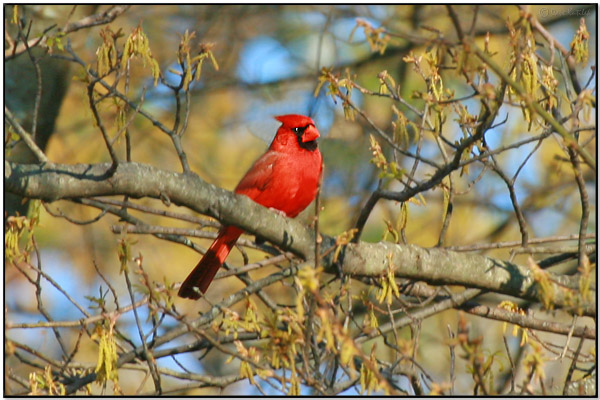
Northern Cardinal (Cardinalis cardinalis) by Daves BirdingPix
Northern Cardinal (Cardinalis cardinalis) by Daves BirdingPix 
What kind of birds is this? Are you kidding, Stephen, that is a wide open question? If you have been following this "Start Birding Today" series you know that Stephen, our Assistant to the Pastor, asked me to do some new articles about birding for our church blog, The Fountain. He came up with the titles and I am writing the articles. This one can go so many directions and involves more effort than our previous blogs, for me and the readers. Now we are getting into the "heart" of birding or birdwatching.

I have been encouraging you to become aware of the birds around you and to take notes about them. This is where all birders begin to learn about the birds. When you go out birdwatching it is nice to go with someone who has been birding for awhile. They can tell you the bird's name and something about it. Even those of us who have been doing it awhile don't know every bird. Being by yourself or just seeing one out your window brings you to this question, "What kind of bird is this? So, what do you do?
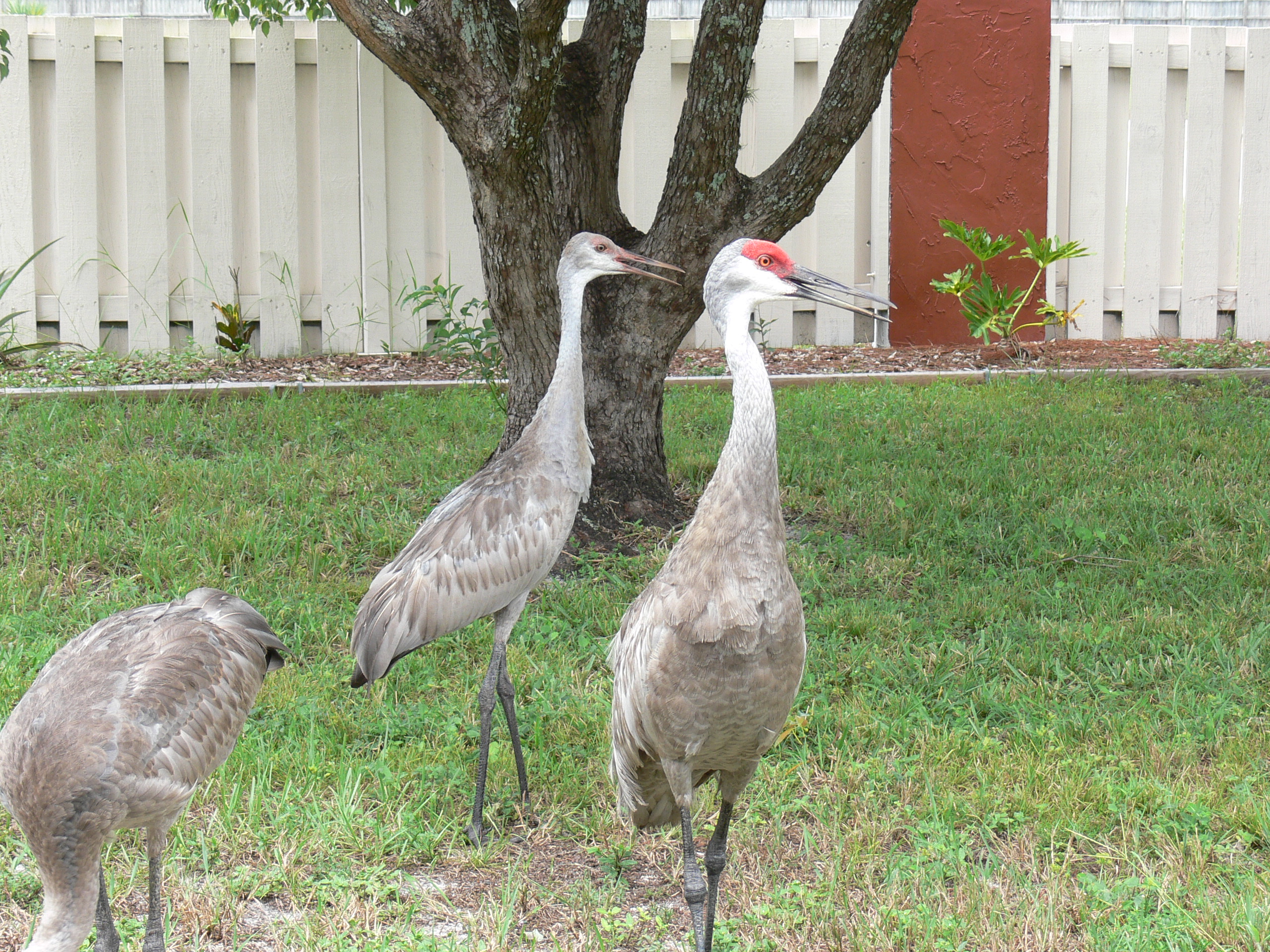
Sandhill Cranes - Adult and Juvenile in yard 8/27/10

Then God said, "Let the waters abound with an abundance of living creatures, and let birds fly above the earth across the face of the firmament of the heavens." So God created great sea creatures and every living thing that moves, with which the waters abounded, according to their kind, and every winged bird according to its kind. And God saw that it was good. And God blessed them, saying, "Be fruitful and multiply, and fill the waters in the seas, and let birds multiply on the earth." So the evening and the morning were the fifth day. (Genesis 1:20-23 NKJV)
This is where Bird Guides come in handy, but here in America there are over 900 species. Now begins the process of elimination. When the Lord created the birds, He did not put name tags on them, but in a way, He did. You will discover that each family of birds differs from other families, yet within families, there are different colors, markings, and subtle differences. If your bird is small and you have seen our local Sandhill Cranes, you can eliminate that whole Crane family. Most have seen a sparrow at one time. Was your bird about that size? Now you can eliminate almost the front half of your Guide. In other words, size is very important as a clue.

Blue Jay at Bok Tower by Dan's Pix
Blue Jay II at Bok Tower by Dan's Pix
What color was it? Another clue. Most guides don't list the birds by color, but there are some that do (The Easy Bird Guide), also on the Internet, there are places to find the bird by color. WhatBird is a great example of this. If you go to the Attributes Page you will see what are the main things to ask about the bird. Notice the list of birds above the buttons, it starts with all 924 birds. As you make selections, the number decreases and you eventually end up with just a few choices to make your selection from.

Location - Where did you see it? Florida, Georgia, etc.
Shape - Chicken like, Duck, Gull, Hawk, Hummingbird, etc.
Size - Very small, small, medium, large, very large
Color - Primary and Secondary colors
Habitat - Was it at the coast, mountains, desert, lake, etc.
Bill Shape - All purpose, cone, curved, dagger, etc.
Bill Length - Same as head, longer or shorter than head
Wing Shape - Broad, long, pointed, rounded, tapered, very long
Backyard Feeder - Frequently or rare
Others - Order, Family, Song pattern or call.

I think for now, that is enough. We will need to cover more in another article. I have put several photos on the page which you probably already know. Try using the What Bird tools and see if you can get to the right bird. Start with the Northern Cardinal. Put in Florida for Location (924 to 362), Shape=Perching-like (362 to 165), Color Primary=Red  (165 to 8), Bill Shape=Cone (8 to 4). You now only have 4 choices to look at. Try it. As you click on the name you will see lots of information about that bird.

Links:
What Bird Tools
How to ID Birds - All About Birds
How to Identify Birds - Audubon
Bird Identification Tips - About.Com Birding/Wild Birds
How-to Videos:
How to Identify Birds
Topography (Parts of the Bird)

Other Posts in our Start Birding today Series:


This Post Sponsored by:

Wednesday, April 25, 2012

Meet Our FBM Missionaries - Tim & Janice Phillips (part 2)

(Tim & Janice Phillips, Mikayla and Jayson)
Today we continue introducing our FBM Missionaries.  Tim & Janice Phillips serve in Niamey, Niger with their two children, Mikayla and Jayson.  Tim & Janice answered our questionnaire separately.  Last time we heard from Janice.  Today we hear from Tim.

Briefly share your salvation experience and your call to ministry.
I was raised in a Christian home in Cedarville, OH. I had many Christian influences around me. As a result, I made a profession of salvation when I was 5 yrs. old and was baptized when I was 8. Growing up, however, proved that the relationship with Christ was more important and that became very evident to me in high school and college. I never intended to be on the mission field. I loved teaching and thought I would always be in America doing just that. Then one of my kids’ dads came to me to ask if I would be willing to go teach in Africa. After a bit of hesitating, I felt this is just what God had for me for a change. Boy, did he change my life that year. Not only did missions become something of importance to me, but I met my wife! I went in single and came out married! My wife and I decided not to pursue going back to Africa just because we met there, but after some time and not us talking about it, we came to the same conclusion that we need to at least pursue it until God closed the door. After much prayer, we decided that we were to return to Africa, but didn’t know where since ICA had just closed its doors. Through many stories too long to state here, we ended up in Niger. While Niger is not a vacation hotspot, I cannot imagine being someplace else The kids are great, the people are great and this ministry to MK’s is just awesome.
What did you do before you were a missionary?
I taught high school history and government at Kokomo Christian High School.
Tell us about your current ministry. Where are you and what are you doing?
We are at Sahel Academy serving as dorm parents to 17 wonderful children with wonderful families.
How long have you been serving as a missionary?
We are completing our 5th year. One year in Quebec and four years here.
What does a typical day look like for you while you are on the field?
For me, there are no typical days which are something I love. I get up, see the kids off to school, and then start on projects. Sometimes I spend time fixing lights, toilets, or an assortment of things. We do all the shopping for the dorm as my wife oversees all the meals. When the kids come home from school, there is homework to help with, projects to do, and sometimes just playing ping pong(I know, tough life ) While the kids are in school, I have spent time talking with our guards, learning language, which is still an ongoing problem for me. I find that building relationships seems to be something I do with not only the MK’s, but also with the Africans. I also help out with the school’s hot lunch program to be sure all have paid and all get what they ordered. I coach softball during the tournament times and play a lot, also. I am sure that there are many more things, but they all run together. I just do things that need to get done.
As you reflect on the years you have spent as a missionary, please share with us some of the highlights of your ministry.
Seeing one of the dorm kids as well as our daughter accept Jesus! After that? I think just watching the dorm kids grow, mature and take on more and more responsibility. This is a rather large family we build here, so to see the dorm kids succeed makes us righteously proud (I learned that word from other missionaries) Watching these teens walk lives that are worthy of our Savior is just incredible!
What have been some of the biggest challenges that you have faced on the field?
Language, the heat, sometimes interpersonal relationships, etc. I always have to tell myself, “these kids are really good kids, don’t major on the minor things!”  You know sometimes when people in general drive you nuts and kids are no different. You ask them to do something and they don’t, so you ask them again, and they still don’t. That is a challenge because of all the different cultures we come from. I often tell the kids when we have to remind them all to do something that this will not make a difference for eternity! There are things way more important.
What person(s) has had the biggest influence on your life?
Really? What a question. Probably John Jackson. He is the man who got me to Africa the first time. At least he planted the seed for God to grow. When he and his family came home from South Africa, his family became my family and I loved the way he guided his family closer to God. But there are many more
What would you say to encourage others (young or old) to consider full-time missions as a profession?
That is a good question. Missions aren’t for everyone, especially here. But I would never say that until they have tried it. A short term mission trip is a great thing when it is not just a two week thing. Those trips are great, but you can’t make a good judgment for a career until you have been someplace a year or two. Take those steps of faith. Kids all the time would ask me what the will of God is for them. My reply was always, “Obey the Word of God!” If you are in the Word, obeying and living it, you will know exactly what God wants in your life. I don’t believe His Will is meant to be secretive. Obey and listen to God.
Please share some specific prayer requests with us.
  • Again, language. I am trying to get more fluent in French, but would love to speak Zarma, also.
  • Consistency as a dorm dad.
  • Good leadership to lead this dorm where God wants it to go… as well as my own family so my two little ones don’t get lost in the mix.
What are some current needs that you have and what can we do to help meet those needs?
Right now, getting ready to come home on furlough, we have no idea of what we are doing. We need a house, a car and money to pay for it all. We have none of those three. We know God will provide when we need them, but it would be easier if we could make plans. I have no idea of how to go about raising funds. With only a year, I know many churches won’t be able to schedule me for at least 8 months to a year and we really need to raise more funds to be able to return here. I just don’t know what to expect, I guess is a better way of saying all that. We really want this year to be a year of recuperation, but also of developing and renewing relationships there in North America. So, please pray that all this gets accomplished and that there are people back in Indiana who are already doing stuff that we don’t know about yet!
Meet Some of Our Other FBM Missionaries:

This Post Sponsored by:
Monday, April 23, 2012

Start Birding Today: Where Do I Go? (by Lee Dusing)


Circle B Bar Reserve Sign


We have answered some of this question already as we have been working our way through this Start Birding Today series. The easiest is to look or go outdoors. That is our starting place.
He sends the springs into the valleys; They flow among the hills. They give drink to every beast of the field; The wild donkeys quench their thirst. By them the birds of the heavens have their home; They sing among the branches. (Psalms 104:10-12 NKJV) The flowers appear on the earth; The time of singing has come, And the voice of the turtledove Is heard in our land. (Song of Solomon 2:12 NKJV)
When you are working in your yard, playing outdoors, walking to your car, talking to a neighbor, getting your mail, or just looking outside, become aware of the birds around you and over you (look up). Birdwatching does not have to be expensive or wearisome. Just let it happen. It will happen, the birds are very plentiful, at least here in central Florida, most of the time. For those who live in colder climates, most of their birds head down here and beyond for the winter, but the Lord has created birds that like the cold and can survive in it. The birds that stay put and don't migrate are called "residents." We have plenty of residents right here and so do you wherever you are.
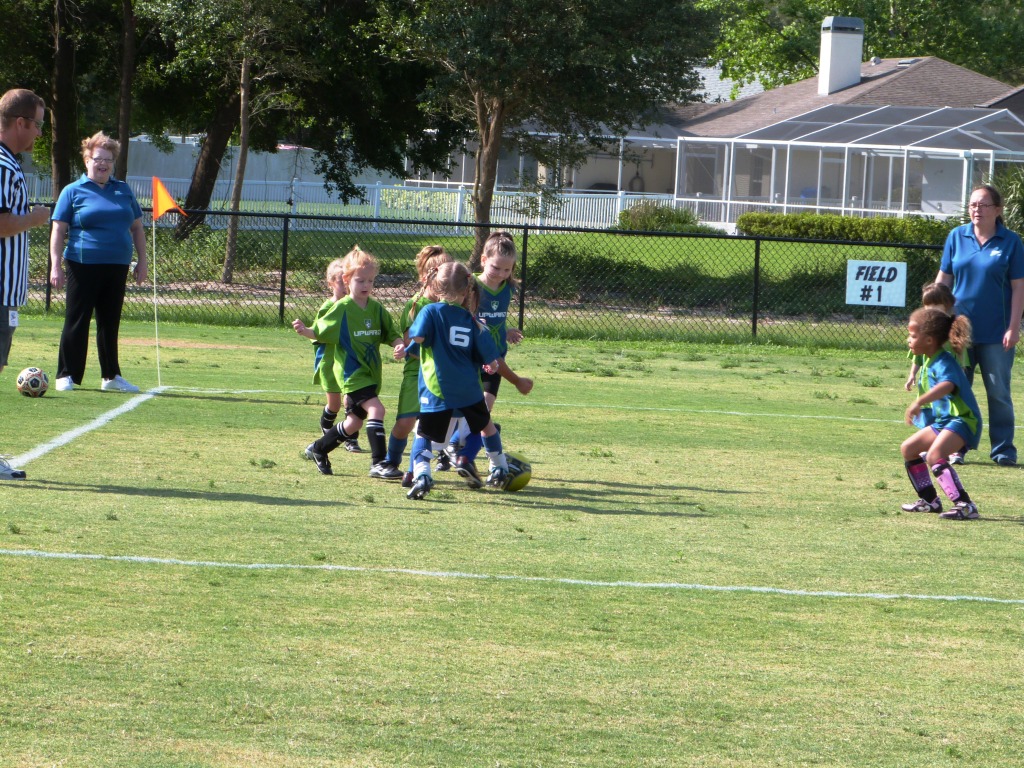
Upward Soccer 4-5 yr olds
Upward Soccer 4-5 yr olds Girls
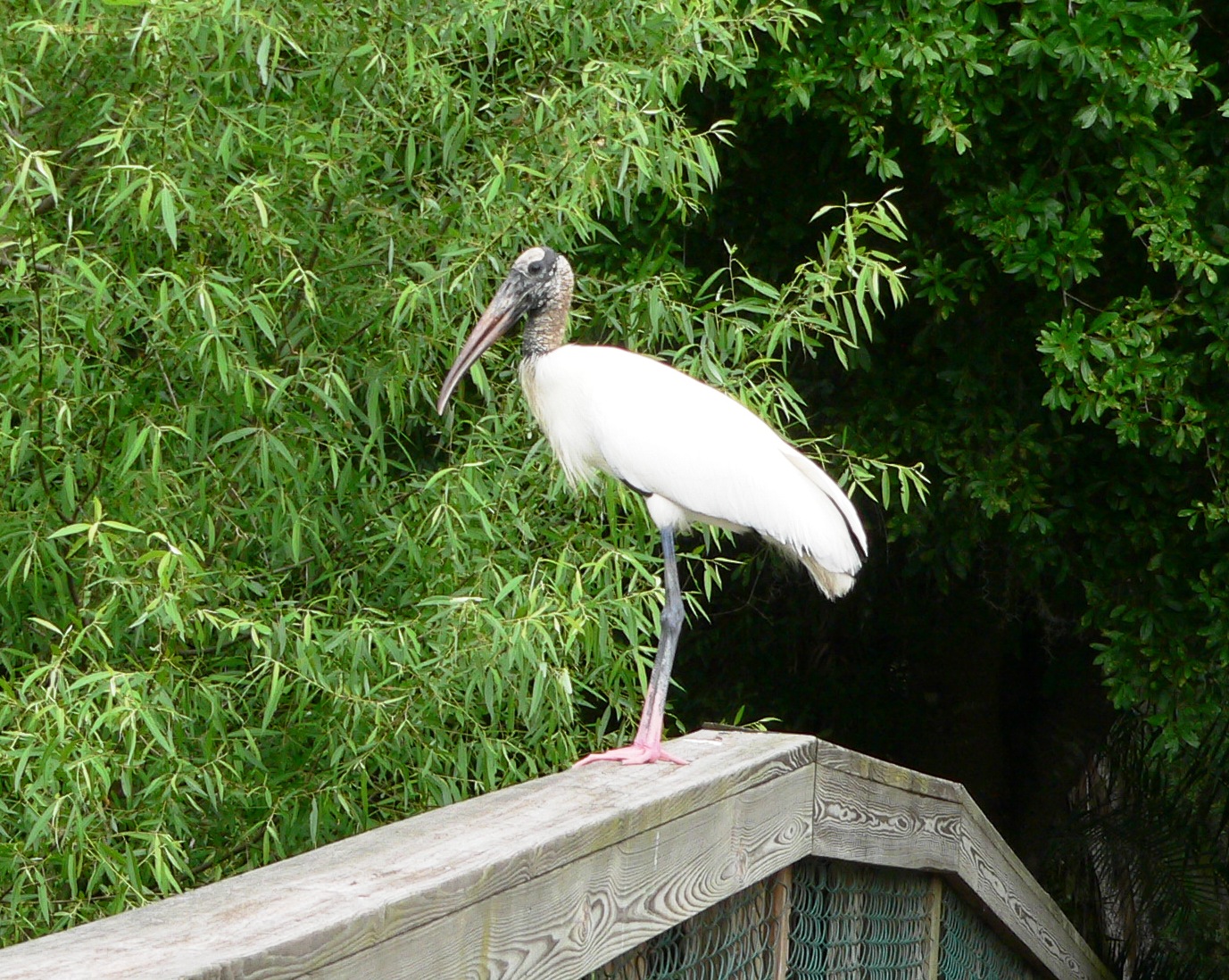
Besides your "yard birds" there plenty of other places to go see what our avian friends are up to. Saturday, while watching our Upward Soccer games at church, I not only enjoyed watching the 4 and 5 year olds try to figure out which goal they were suppose to kick the ball in, but I observed 1 Bald Eagle, 1 Turkey Vulture, 2 Ospreys, 7 White Ibises, 1 Wood Stork, 1 Great Egret, 1 Boat-tailed Grackle, 2 Anhingas fly overhead. I also saw the baby Mallard that the Mincey's had in a cage. Did you see any of them, those of you that were there?
Anhinga Flying Over Soccer Fields
At the top of the article I placed a photo of the Entry Sign to our neatest place to go birding or birdwatching in this area, the Circle B Bar Reserve. Birding enthusiast from all over the state come here to go watching the birds. It is becoming a prime "hot spot" because of the variety of birds found out there. "The bird list for this property exceeds 185 species making it a must see birding location.  The best season for birding is winter although any season can turn up unusual bird. Spoonbills, Wood Storks, Limpkins, and many species of wading birds are easily seen and photographed from the hard surface trails." (Polkcountybirds) We watched or heard 85 ourselves out there.
  
Locally there are several nice places to get near the birds. The South Lake Howard Nature Park, Lake Hollingsworth, Lake Morton and Lake Parker Park, Saddle Creek Park. All five of those places are nearby, do not cost to get in and the birds are usually active enough to start your birding adventure easily. Those in other areas also have nearby parks, preserves, refuges, lakes and other place to visit the birds with little or no cost. Here in Polk County we have over 500 lakes and surely there are birds on, over or near them.
  
As you get more adventurous, start expanding your areas to explore. The Internet, bird magazines and bird books will give you ideas of places to go. Zoos make for great places to see birds. Not only the captive ones, but there are what I call the wild "free-loaders" who are eating the zoo animals food or at least trying to grab a meal.

More places to visit: The beach, Wildlife Refuges, parks, State Parks, National Parks, Wetlands, Everglades, Great Florida Birding Trail, on and on. Oh, and don't forget the local store or parking lot. Look in their trees and the letters of their signs. A favorite place for birds like Sparrows. Sometimes they are even in the store. The other day we were in Lowes and they were into the bird seed. They had broken open several bags and were having a wonderful time. Not so sure the company was as happy.
Look at the birds of the air, for they neither sow nor reap nor gather into barns; yet your heavenly Father feeds them. Are you not of more value than they? (Matthew 6:26 NKJV)
You can get as much involved as you desire in birding. Some travel around their country and around the world to see birds. I enjoy watching the birds, and seeing the Lord's Creative Hand at work, but I just enjoy birdwatching wherever I am. With over 10,000 birds in the world and at my age, I think I will let the others go take the photos and videos and see them through their lens. Would I like to go where they are? Sure, but there are plenty in my paths for me to enjoy. So can you, so Start Birding TODAY wherever you find yourself.

   
This Post Sponsored By:

Wednesday, April 18, 2012

Can We Trust the Bible? The Hebrew Old Testament (by Lou Gentry)


How We Got Our Bible:  The Hebrew Old Testament

The Two Testaments
The word “testament” in the designations “Old Testament” and “New Testament,” goes back through the Latin testament to the Greek diatheke, which in most of its occurrences in the Greek Bible means “covenant” rather than “testament.” In Jeremiah 31:31, a new covenant is foretold which will supersede that which God made with Israel in the wilderness (cf. Exod. 24:7ff). “By calling this covenant ‘new,’ he has made the first one obsolete” (Heb. 8:13). The NT writers see the fulfillment of the prophecy of the new covenant in the new order inaugurated by the work of Christ; His own words of institution (1 Cor. 11:25) give the authority for this interpretation. The OT books, then, are so called because of their close association with the history of the “old covenant”; the NT books are so called because they are the foundation documents of the “new covenant.” The terms “Old Testament” and “New Testament” for the two collections of books came into general Christian use in the latter part of the second century.
The Old Testament
The Hebrew OT is arranged in three divisions. First is The Law, also known as the Pentateuch. It includes the “Books of Moses” (i.e., first five books of the OT). It was the first section of the OT to be recognized as canonical. It is generally accepted that it was both complete and canonical by the time of Ezra and Nehemiah in the 5th Century B.C.--may have been so considerably earlier.
Second is The Prophets. It includes four books of earlier Prophets and four books of later Prophets. These eight books include Joshua, Judges, Samuel, Kings, Isaiah, Jeremiah, Ezekiel, and the Minor Prophets (counted as one book).
The third division is The Sacred Writings (Hagiographa). It includes the books of Ruth, Chronicles, Ezra-Nehemiah, Esther, Job, Psalms, Proverbs, Ecclesiastes, Song of Songs (Solomon), Lamentations, and Daniel.
These three divisions total 24 books. In the first century these three divisions were differently arranged into twenty-two books. Two of the smaller books were combined with others. Regardless of the arrangement, the included books contain all of the 39 books incorporated into the Bibles we use today.
  • Our next article looks at how the Septuagint came to be.
       
  • Return to our Introduction Post to see a list of all posts in this series.
        

Meet Our FBM Missionaries - Tim & Janice Phillips (part 1)

(Tim & Janice Phillips, Mikayla and Jayson)
Today we continue introducing our FBM Missionaries.  Tim & Janice Phillips serve in Niamey, Niger with their two children, Mikayla and Jayson.  Tim & Janice answered our questionnaire separately.  So, today we will hear Janice's answers.  Next time, we will hear from Tim.

Briefly share your salvation experience and your call to ministry.
I took you from the ends of the earth, from its farthest corners I called you. I said, 'You are my servant'. I have chosen you and have not rejected you. So do not fear, for I am with you; do not be dismayed, for I am your God. 
I was born in Toronto, Ontario, Canada. When I was 7 our pastor's daughter was baptized, through her testimony it dawned on me that I needed to make my own profession of faith, so I knelt in the pew and asked Jesus to forgive me and committed my life to him. When I was 17 my parents moved to Quito, Ecuador. I went to the Alliance Academy to do grade 12. I saw missionaries up close and personal... anyway the experience changed my life. I came back to Canada and started school in Regina, Saskatchewan to become a missionary. After earning a BA in Biblical Studies and an MA in missiology I went to Bouaké, Côte d'Ivoire to Bethel Dorm to be a Dorm assisstant. I was there from 1991-2001, where I met my sweetie who is now my husband, Tim (and still my sweetie). Our daughter Mikaylah was born in 2004 and our son Jayson was born in 2006. We now live in Niamey, Niger where we serve as dorm parents at the Sahel Academy.  

What did you do before you were a missionary?
I spent one gap year working at Instant Custom Signs as a manager. I spent another year helping in a church plant in rural Ontario. I also had odd jobs at the YWCA and Menard's (a hardware store in Indiana).
Tell us about your current ministry. Where are you and what are you doing?
Currently my husband Tim and I are "Co-parents" to 17 teenagers at the Sahel Academy, in Niamey, Niger, West Africa. Our "kids" come from five different "passport countries" Including Benin, Great Britain, Korea, New Zealand and USA. Their parents work in rural Niger, Ghana, Benin, Burkina Faso and Togo. Their parents are in remote villages where there is no way to educate their children. We provide a home away  from home so the teens can study at Sahel Academy.
How long have you been serving as a missionary? 
Since 1991.
What does a typical day look like for you while you are on the field?
Our day usually starts about 6am... after breakfast and morning routine the kids are off to school by 7:25 depending on the day there is either shopping, Bible Study, Dorm Staff meeting or Moms in Touch Prayer Meeting.  I am also directing our house helpers.  I provide lunch for our house workers and our smallest child is in Kindergarten so he comes home for lunch too. We try to have Siesta after lunch, make snack ready for the kids when they get home from school, then there are piano lessons, homework, supper prep, and after supper devotions. The bedtime routine begins at 7pm and usually all the kids are in bed by 10:30 or 11, depending on the crises of the day :) The weekends are a little more lax but, with 21 people in the house you can imagine the energy :)
As you reflect on the years you have spent as a missionary, please share with us some of the highlights of your ministry.
Mentoring kids through their teen years has its own joys and sorrows. Adding the fact that none of these children are in their native culture or living with their nuclear family. Now that many of "my kids" are grown up and are using their lives to glorify God and shine for him wherever they are from Korea to Africa to Europe, Canada and the USA, I am humbled and rejoice that the Lord has allowed me to have an influence on so many.
What have been some of the biggest challenges that you have face on the field?
Probably one of the biggest challenges is raising our own children within our "transient" family. Dealing with the grief of saying "good bye" is something that never goes away, something that we all must deal with until we are finally home in heaven.
What person(s) has had the biggest influence on your life? 
Hands down my parents.
What would you say to encourage others (young or old) to consider full-time missions as a profession?
While God can be glorified wherever you are and you can serve him no matter what you do for a living, I can't get away from the huge need for personnel.  I have yet to see a ministry that has said "we have plenty of workers, don't send any more"!  It feels like much of our prayer time is dedicated to begging God to provide more workers.
Please share some specific prayer request with us.
Ha ha, more workers :)   Personally, we are begging God daily for wisdom.  It seems that we are often making decisions that effect us, our kids or our workers or colleagues that are life-changing.  So, please pray that we will make wise God-centered decisions.
What are some current needs that you have and what can we do to help meet those needs?
We are coming up to our first home assignment as a family. This will be the first time our son has lived in the US and the first time our daughter will remember being in the US. We need to find a place to live, a school for our children to attend and a vehicle to get us around for a year. While we are looking forward to Taco Bell and Target and renewing relationships with our friends and family, it is actually stressful to think of all that has to be done within the year that we are in the US.
Meet Some of Our Other FBM Missionaries:


This Post Sponsored by:
Monday, April 16, 2012

Start Birding Today: The Few Tools You Need To Be A Birder (by Lee Dusing)

Savannah Sparrow by Ray Barlow
Surprisingly when I put "open" and "eye" into my Bible search with e-Sword to find a verse for this article, I found 49 verses that had both words. The reason for a verse with your eyes being open, is because that is your first tool you need as a birdwatcher when you go birding is your eyes. Here are a few examples:
  • Gen 21:19  And God opened her eyes, and she saw a well of water; ...
  • Num 22:31  Then the LORD opened the eyes of Balaam, and he saw the angel of the LORD standing in the way...
  • 2 Kings 6:17 And Elisha prayed, and said, LORD, I pray thee, open his eyes, that he may see. And the LORD opened the eyes of the young man; and he saw: and, behold, the mountain was full of horses and chariots of fire round about Elisha.
  • 2 Kings 6:20 ... that Elisha said, LORD, open the eyes of these men, that they may see. And the LORD opened their eyes, and they saw; and, behold,
  • Psalm 119:18 Open thou mine eyes, that I may behold wondrous things out of thy law.
  • Matt 20:33 They say unto him, Lord, that our eyes may be opened.
I know these verses do not apply to birding or birdwatching, but I think they reveal some truths that do apply. The LORD or God opened their eyes. Would it be wrong for us to ask the Lord to open our eyes to see His marvelous creation, especially the birds? Once their eyes were opened, they saw different things. We are going to see different birds on different outings.

Also, Christ said in the Sermon on the Mount: "Look at the birds of the air:..." (Matthew 6:26 ESV)

The second "tool" that is very useful is your ears. Some people cannot see because of blindness or poor sight, but does that keep them from birding? No!  Fanny Crosby was blinded early in life, but in my opinion, she was a fantastic birder. She may not have seen, but she "heard" the birds. When I first started my research for Birds in Hymns, of the first 44 hymns I found 10 were written by Fanny Crosby! Here are two examples:
  • "Happy am I, the bird is singing" - Tried and True
  • "And the bird in the greenwood is singing with glee" - Praise the Giver of All
Listening to the sounds around you can reveal hidden treasures. Birds sing, call, alert other birds of danger, make sounds with their wings, etc. Having our ears open to their sounds can help locate them. After awhile, with a little practice, you will recognize birds just by their calls and songs. Even if you never see the bird, the avian friend can be counted on your "life list," but that is another article.

The first two tools, Eyes and Ears, could be summarized as "Awareness." If you are not aware of the birds, you will miss finding them. Basically, those two tools are all you need.

Yellow-throated Warbler by Bob-Nan
Third: To find the birds and see them closer, a pair of binoculars are very useful. It is not required, but I use mine most of the time to observe better details that help me identify the birds. There are lots of articles in books and on the Internet about which pair to buy, what strength they should be, how much to pay, etc.

So what should you buy? Every birdwatcher will give you different thoughts, but here is what I have. I use a 8 X 42 lens. "The first number is the power of magnification of the binocular. With an 8x42 binocular, the object being viewed appears to be eight times closer than you would see it with the unaided eye." "The second number in the formula (8x42) is the diameter of the objective front lens. The larger the objective lens, the more light that enters the binocular and the brighter the image." (Bushnell) There are things like the kind of lens, coating, field of view, etc. that you can get from their site and others.

My only other advise is not to buy a 10X or larger because it is harder to hold the image steady, at least for birding.

The fourth "tool" would be a small notebook to keep a list of the birds you see. Even if you don't know what they are at first you can still make notes of what they looked like, colors, sounds, beak shape, feet, wings, time and date, and other notes about your observing the bird. Later, that will help to identify the bird. More on "Lists" in another article.

The last main tool would be a Bird Guide to find out which bird you just saw. (Again, another article) You can use the Internet to assist in that also, like What Bird.

There are other tools that are useful, but when you first Start Birdwatching Today, they are not a necessity, but in time, they also become very useful. Here are a few:
  • Camera - helps with ID and enjoyment later
  • Spotting Scope - great for birds far away
  • Audio Tapes of Birds - to learn their songs
  • Handheld Electronic Devices - helps ID in the field
We are trying to keep this series simple, at least at first, so that you realize that you can "Start Birding TODAY"

 Informative Links:
     
This Post Sponsored by:

Wednesday, April 11, 2012

Someone You Know Trusts Planned Parenthood (by Stephen Simpson)


"Someone you know trusts Planned Parenthood"

Really?  Can this be true?  I recently saw this message printed on a new billboard in our town.  Previous billboards at this location have been much better.  They have promoted mouth-watering ribs from Sonny's or a local A/C contractor.  But now, a giant billboard from the nation's largest abortion provider greats all who drive by.

I have never been into a Planned Parenthood office.  I am afraid to go.  I am afraid of the emotions that would overwhelm me.  I am afraid that I would look at each employee or volunteer and wonder "How many unborn children have you helped murder?"  I cannot fathom trusting Planned Parenthood.  "Trust" and "Planned Parenthood" do not belong in the same universe, much less on the same billboard.

There are many things in life that we should trust.  I trust my children's pediatrician.  I trust him completely to care for my children.  I trust my Pastor.  I trust that he will always tell me the truth - regardless of whether I like it.  I trust my insurance agent.  He has provided sound advice and is a good friend.  Most of all, I trust my Savior - Jesus Christ.

But, I do not trust Planned Parenthood.  Why would I trust an organization that profits from the destruction of life?  How can I trust an organization that murdered 331,796 unborn children in 2009 and another 329,445 in 2010?  (source)  Each abortion they perform destroys an unborn life and grievously harms the life of the mother.

One who trusts Planned Parenthood is like the child who whines and cries to get whatever he wants.  The child says, "I want a candy bar."  The parent replies, "no."  The child then whines and cries and stomps on the ground.  Finally, the parent decides, "Fine.  You can have the candy bar."  In the child's mind, they have just solved their immediate problem.  All their troubles are over.  Tragically, the child does not see the dangerous path he is traveling on.  He does not realize that he is on his way to being an adult who pitches fits to get whatever he wants.

Trusting Planned Parenthood is just like this.  A woman experiences a legitimate crisis.  Often it is an unplanned pregnancy.  She is unsure what she should do.  Planned Parenthood offers her a quick and easy solution to her problems.  She does not like the solutions she hears elsewhere.  To her, they all sound like the parent who says "No."  So, she decides to 'trust' Planned Parenthood.  Just like the child, she gets her 'candy bar.'  Just like the child, she fails to realize the dangerous path she is headed down.  She has started down a hard road of grief, regret, and guilt.

There are many solid alternatives to Planned Parenthood that are worth trusting.  But, they do not offer quick and easy solutions.  Rather, they offer long-term solutions.  They offer hope.  The best of these alternatives offer salvation through Jesus Christ.

So, please, I beg you, do not ever trust Planned Parenthood.  At first it may seem like they have helped you.  But, in the long run you will see that they were not worthy of your trust. 

Related Posts:
     
Trees Aren’t the Only Things Worth Saving | Abort73.com

Monday, April 9, 2012

Start Birding Today: Why Should I Go Outside and Stare at Birds? (by Lee Dusing)

Marian (Naturalist at Avon Park Range) and Lee
Marian (Naturalist at Avon Park Range) and Lee 
I almost cracked up when I read the title Stephen gave me for this blog. He gave me the suggested titles and I am suppose to write the articles. Some deal! We would like this series to be informative, but mainly to encourage all of us to "start birdwatching today" no matter our level of experience.

So, why should you go outside? Mainly, because that is where most of the birds are. Yes, there are some in cages in peoples house, but the majority are outside flying freely about waiting for you to come watch them. The birds are busy doing what the Lord designed them to do; singing, building nests, eating, finding food for their young, arguing sometimes (especially those in the Dove-Pigeon family), Why do they argue? They are actually showing dominance or defending their territory, or who knows what else. If you are not outside, you might miss all this. You can watch through your window, so even those who are ill or handicapped, can still get to enjoy the antics of our avian friends.

According to Job, you might even learn something from watching the birds:
But now ask the beasts, and they will teach you; And the birds of the air, and they will tell you; (Job 12:7 NKJV) Who teaches us more than the beasts of the earth, And makes us wiser than the birds of heaven? (Job 35:11 NKJV)
Wood Stork at S. Lake Howard Nature Park
Wood Stork at S. Lake Howard Nature Park 
Stare at the birds? If you do that to a person, they get upset, but I am not sure a bird would, but then again they just might. One of the things I was taught when I first became interested in birding or birdwatching was to have "soft eyes." If you stare at a tree or a certain area, you might see a bird. If you look at a tree, but not stare, then you can catch movement or activity in that tree that you might miss if you are only staring at one spot.

Are there times to stare? When I am really concentrating on a bird that I have already spotted, then, yes, I will stare as I try to observe details about the bird. But we will save those details for another blog.

Enough for this article. So either slide your chair or wheelchair up to the window, or go outside and stare at the birds, after you find one.

Other Posts in our Start Birding today Series:
  
This Post Sponsored by:

Thursday, April 5, 2012

April Faith Day 2012 Report

Sunday, April 1st, 2012, was April Faith Day.  It was simply amazing to see what God did through our April Faith Day Offering.  Consider these 'offering stats.'
  • The 2012 April Faith Day Offering was over $130,000.
  • A total of 172 contributions were given towards the offering.
  • The average contribution was $764.05.
  • The largest single contribution was $15,000.
  • The smallest contribution was $1.27.
  • Almost 64% of the gifts were under $500.
  • There were 40 gifts of $500 or more.
  • There were 15 gifts of $1000 or more.
  • There 3 gifts of $10,000 or more.
There is one big lesson we can learn from this year's April Faith Day offering - God cannot be limited.  In the conversations I have had, most have been stunned by this year's offering total.  Most of us thought that the offering would be considerable lower.  We assumed that giving would be down.  We assumed wrong.  God had other plans.  He once again reminded us that He will do whatever He pleases.  He is in control.  We simply are tools in His hand.  May this year's April Faith Day offering serve as a reminder that we cannot limit God.
  

Related Posts:
      
This Post Sponsored by:

Wednesday, April 4, 2012

Can We Trust the Bible? Introduction (by Lou Gentry)

Last year, I was given the privilege of delivering the message for three Wednesday night services. On two of these nights, the topic discussed was, “Why We Can Trust The Bible?” Two 25-30 minute messages cannot do justice to this topic--in fact, many books have been written on it. As a result, I have been asked to do a series expanding upon these two messages. It is appropriate, perhaps, that we look at this subject inasmuch as 2011 was the 400th anniversary of the first printing of the King James Version of the Bible.
  
The foundation of this series will be the book by Erwin W. Lutzer, Seven Reasons Why You Can Trust The Bible, although many other sources will be used. A listing of these sources will be posted at some point during the series. The following outline provides information as to what topics will be covered during the forthcoming months:
 
INTRODUCTION

HOW WE GOT OUR BIBLE

THE OLD TESTAMENT

THE NEW TESTAMENT
  • Canonicity
    • Reasons for a New Testament
    • Development of the New Testament
    • New Testament Apocrypha Books
  • External Evidence Supporting the Reliability of the N.T.
    • Manuscript Evidence
      • Comparison with Other Ancient Literature
      • Transmission of Manuscripts
      • Reliability of the Early Manuscripts
CONTRIBUTION OF THE HOLY SPIRIT

INERRANCY
  • Definition
  • The Biblical Basis of Inerrancy
CONCLUSION

I trust the information which will be presented will not only strengthen your faith in the reliability of the Scriptures, but also enable you to better refute the doubts expressed by non-believers. Stephen and I would welcome your comments at any time throughout this series of articles.

This Post Sponsored by:

Monday, April 2, 2012

Start Birding Today: Some Background Information (by Lee Dusing)

Silver-breasted Broadbill (Serilophus lunatus) by Peter Ericsson
Silver-breasted Broadbill by Peter Ericsson 
We know from Genesis 1 that the God created the birds, along with everything else. They were created on the fifth day. When Adam became conscience, the birds and critters were already present for him to discover and enjoy.
Then God said, "Let the waters abound with an abundance of living creatures, and let birds fly above the earth across the face of the firmament of the heavens." So God created great sea creatures and every living thing that moves, with which the waters abounded, according to their kind, and every winged bird according to its kind. And God saw that it was good. And God blessed them, saying, "Be fruitful and multiply, and fill the waters in the seas, and let birds multiply on the earth." So the evening and the morning were the fifth day. (Genesis 1:20-23 NKJV)
Then the LORD God brought the birds to Adam to let him give them a name.
Out of the ground the LORD God formed every beast of the field and every bird of the air, and brought them to Adam to see what he would call them. And whatever Adam called each living creature, that was its name. (Genesis 2:19 NKJV)
Psalm 111 reminds us that the things that were created are great and are to be "sought out" and enjoyed.
The works of the LORD are great, sought out of all them that have pleasure therein. His work is honourable and glorious: and his righteousness endureth for ever. He hath made his wonderful works to be remembered: the LORD is gracious and full of compassion. (Psalms 111:2-4 KJV)

Galah (Eolophus roseicapilla) and Dan
Galah and Dan at Brevard Zoo 

Fast forward to today. If Adam was to enjoy the birds and put names on them, should we not try to discover them, enjoy them, and try to figure out what their names are?

The birds are all around us, in the sky flying or gliding on the wind (currents), on the power lines, on feeders, on bushes, in trees, or singing or calling in the distant. (Sometimes they are even on cameras.) 

Start birdwatching today for pleasure and realize the goodness of the Lord to us.